
Bring distributed recordings under control
Connect supported PBX, SFTP, S3, cloud and repository workflows without forcing every operation into one storage pattern.

Wherever your recordings live—3CX, SFTP, an S3 bucket, private cloud or another approved repository—we organise, protect and turn them into searchable operational intelligence.
Encrypted workflowAI classification active
A traditional recorder stores a file. VOIPBIRD designs the control, context and workflow that make the recording useful across complex operations.
Connect supported PBX, SFTP, S3, cloud and repository workflows without forcing every operation into one storage pattern.
Apply supported encryption, authenticated transfer, scoped access and audit controls around files and metadata.
Organise access by tenant, customer, product, campaign, process, team, agent or another business rule.
Turn eligible audio into searchable text, summaries, keywords, sentiment and structured outcomes.
Attach the transcript and result to a sales lead, enquiry, support ticket, CRM record or quality-review task.
Where the platform and use case support it, evaluate live events and trigger recording, classification, routing or action during the call.
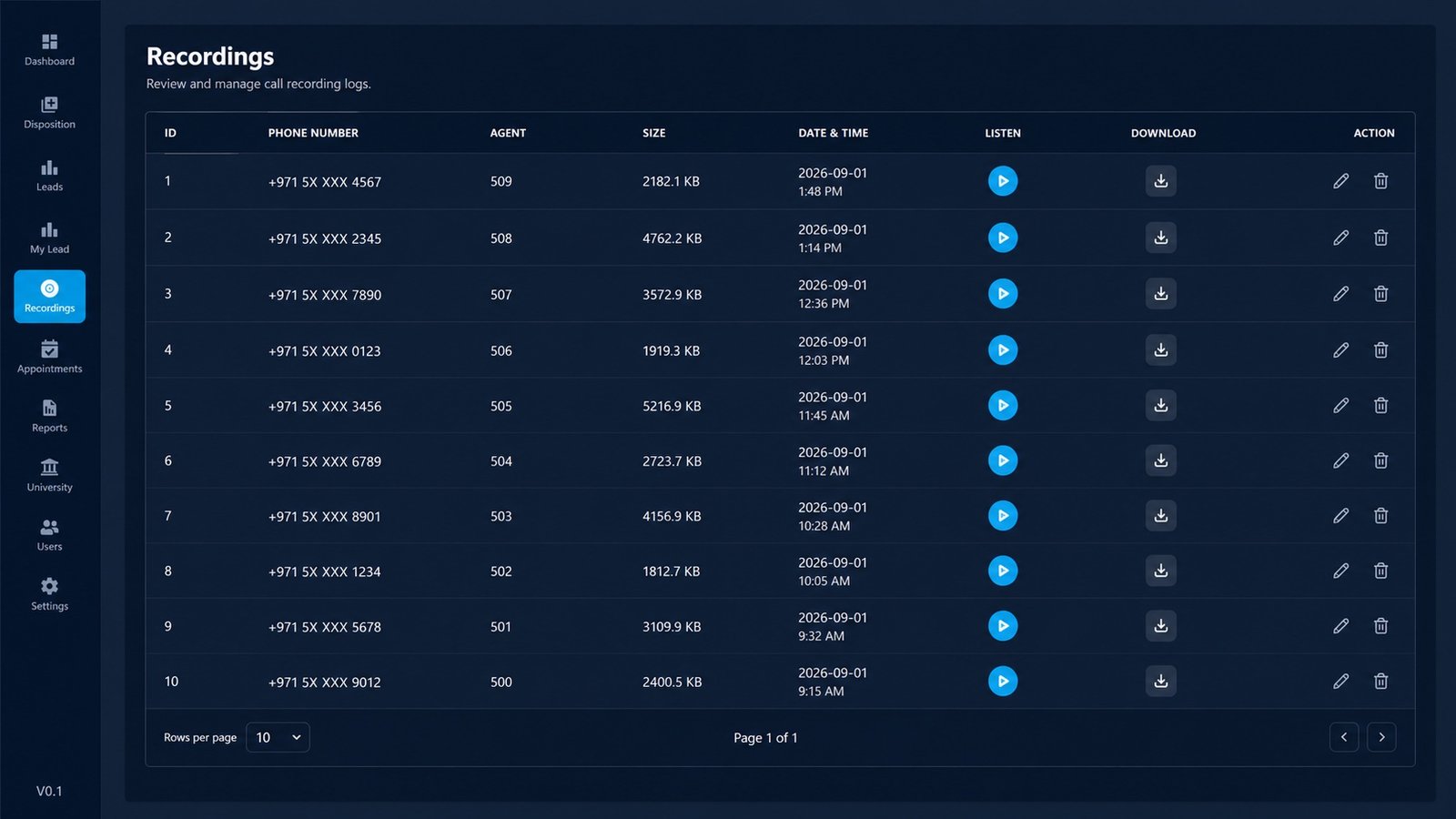
A clean search and playback interface is the visible layer. Behind it, the recording can carry the context required to govern access and complete the next action.
The design follows the recording from capture to storage, access, analysis and action—with ownership and traceability at every layer.
Identify the eligible conversation, channel, queue and recording event.
Authenticate endpoints, encrypt supported transport and validate delivery.
Tag tenant, product, process, team, agent, customer and retention class.
Generate approved text, sentiment, summary, keywords and classification.
Push results to CRM, sales, enquiry, QA or support-ticket destinations.
Complex organisations often run multiple products, teams, processes and customer operations. We model that structure instead of leaving every recording in one undifferentiated archive.
TENANT / CUSTOMERPRODUCT / PROCESSTEAM / QUEUEUSER / AGENT
Keep customer or business-unit recordings within their approved boundary.
Distinguish sales, service, collections and product-specific conversations.
Give leaders access to the queues and teams they are responsible for.
Apply role and ownership rules to playback, review, export and action.
Connect a recording to the workflow, disposition and retention class it belongs to.
Record supported access and workflow events for operational review.
Yes—where the PBX, media path, AI service, permissions and use case support it, we can engineer real-time or near-real-time processing. The result can influence routing, start or stop an approved recording action, create an alert, classify intent or prepare the next workflow step.
The final control set depends on the PBX, storage provider, integration interfaces, retention requirements and your information-security policy.
Use supported secure protocols, endpoint validation and delivery checks between systems.
Apply supported storage encryption and key-management controls appropriate to the repository.
Scope search, listening, download, deletion and administration to approved roles.
Define how long each recording class remains available and how approved deletion is handled.
Yes, subject to the available interfaces and permissions. We can design workflows around S3-compatible storage, SFTP, private cloud, on-premises repositories and supported APIs while keeping metadata searchable.
Yes. The access model can be designed around tenant, customer, business unit, product, process, queue, team, agent and role boundaries.
Yes, where the destination has a supported interface. Approved transcripts, summaries, intent, sentiment and dispositions can be attached to sales leads, enquiries, CRM records, quality tasks or support tickets.
Real-time or near-real-time processing is possible in supported architectures. Feasibility depends on the PBX/media path, AI engine, latency, licensing, permissions, privacy requirements and the exact action required.
No. A secure design also needs identity, least-privilege access, key handling, auditability, retention, deletion, monitoring and a documented response when transfer or processing fails.
Show us where the audio lives, who should access it and what should happen after every conversation.